
Clark Federal Release Scope
The Federal Bureau of Prisons operates a nationwide prison system. Its locator matters to Clark County only when the person was a federal prisoner. An ordinary Clark County arrest, a booking at Meade County Jail, an overflow stay at Ford County Jail, or a Kansas state-prison commitment belongs to a different system. Similar terms such as inmate, hold, transfer, and release do not make the records interchangeable.
BOP’s public locator covers federal inmates from 1982 forward. It can show a former federal prisoner’s name, register number, demographic details, release date, and location or release wording. For older federal records, BOP directs researchers toward the National Archives and Records Administration with identifying information and an approximate period of incarceration. A Clark County court case is not proof that BOP ever held the person; the charging court and sentence determine the system.
Search BOP Release Records
Open the official BOP Inmate Locator. The number search accepts a BOP register number, DCDC number, FBI number, or INS number. A number is usually the best route because names can collide. The name search allows first, middle, and last name plus age, race, and sex. Begin with the most precise data lawfully available, then compare every displayed identifier before opening or relying on a match.
- Choose number search when a federal identifier appears in the docket or paperwork.
- Otherwise search the complete federal commitment name and add available identity details.
- Compare register number, age, and other displayed fields.
- Read the location, “Released,” or “Not in BOP Custody” wording exactly as shown.
- Match the result to the federal docket and save the search date.
The manifest’s BOP image comes from that official source. The live BOP locator should always be checked because status and projected dates can change.
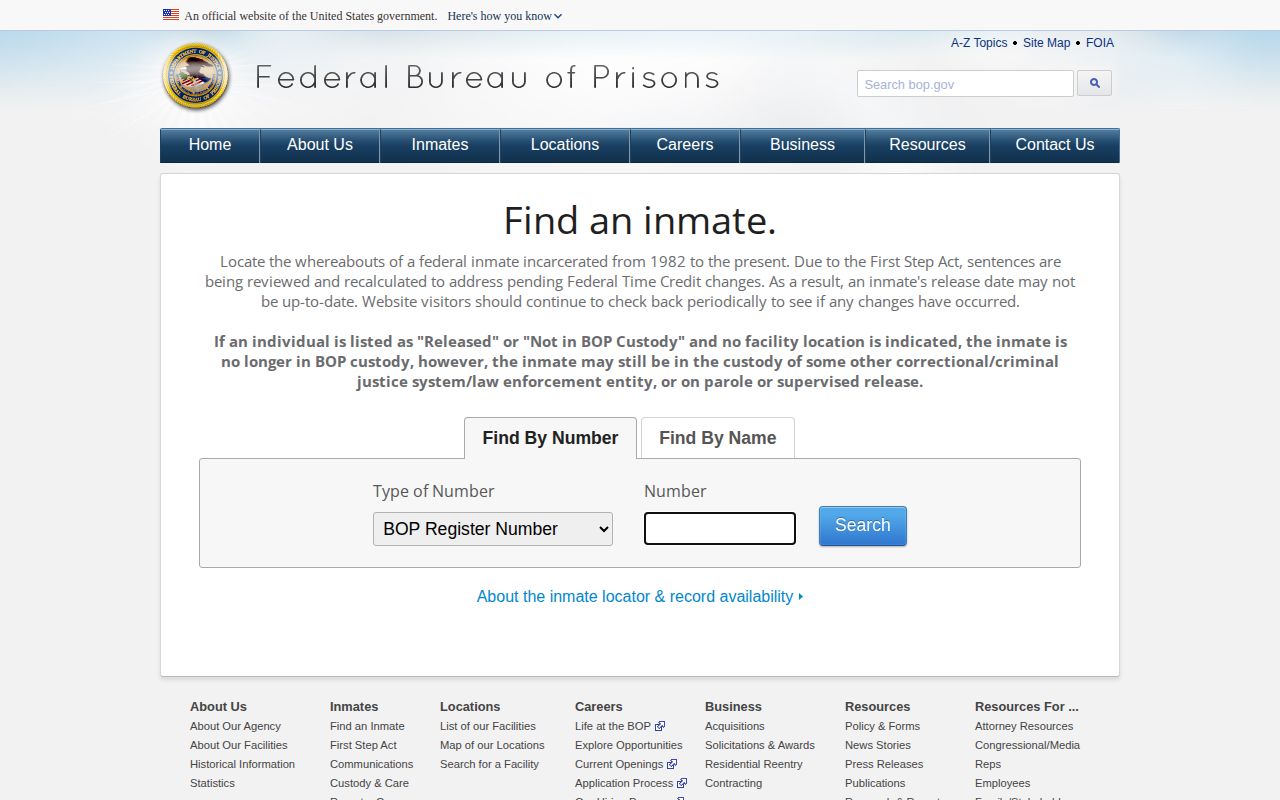
The locator screen shows why both search routes matter: a federal identifier sharply narrows a result, while a name search needs careful identity comparison.
Interpret Federal Release Status
A BOP result marked “Released” or “Not in BOP Custody” establishes a limit, not a universal conclusion. It means the person is no longer held by BOP according to the displayed record. The person could be living in the community, serving federal supervised release, held by another sovereign, transferred to immigration custody, or involved in a new case. The locator does not replace the court docket or a receiving agency’s record.
Release date also needs its label. A displayed historical date may record the end of BOP custody, while a date for a current prisoner may be projected. Federal calculations can change, including after sentence corrections or First Step Act credit recalculation. Do not recast a projected date as a guaranteed departure date. Check the federal judgment, later docket entries, and current BOP display.
| BOP result | Next confirmation |
|---|---|
| Current institution | Use BOP facility and case information |
| Projected release date | Recheck BOP and federal docket |
| Released | Confirm date and any supervised-release term |
| Not in BOP custody | Check court, USMS, ICE, state, or county path as facts warrant |
| No result | Verify spelling, identifiers, pretrial status, and system |
Federal Pretrial Custody Differs
The U.S. Marshals Service generally holds federal defendants before trial and during transport. A federal pretrial detainee may be placed in a contract county jail without appearing as a sentenced BOP prisoner. This is a common reason a federal case exists while BOP’s locator yields no useful result. USMS does not offer an equivalent nationwide public historical release locator.
Use the federal docket to identify detention, bond, remand, sentencing, and commitment events. PACER, the District of Kansas clerk, counsel, the actual jail, or a properly directed USMS records request can fill gaps. If Meade or Ford held the person under federal authority, that jail may document admission, departure, and receiving agency, while the federal court explains the legal basis. A transfer from a county jail to USMS or BOP is continued custody, not community release.
The USMS prisoner information page explains the agency’s federal detention role. Use it to understand custody responsibility, then seek the person-specific event from the court or actual custodian.
Match the Federal Court Record
A federal docket can explain facts the locator does not show. Review the charging document, detention or release order, plea, judgment, sentence, commitment, sentence reduction, revocation, and supervised-release entries. Supervised release is court-ordered federal oversight in the community after prison. It is different from Kansas parole or mandatory postrelease supervision, and the Dodge City KDOC parole office does not administer it.
If the docket shows a prison sentence, use the register number and judgment details to confirm the BOP match. If the docket shows pretrial release, BOP may never have been the right system. A later revocation can return a person to federal custody even after an earlier release. The docket and locator form a pair: one explains the legal case; the other reports BOP custody and release history.
Clark County is within Kansas, but a federal case connected to the county belongs in federal court rather than Clark District Court. The Kansas district portal covers state district cases. Do not interpret a blank Clark County state docket as evidence that a federal case ended.
Request Federal Release Records
BOP’s locator is a public lead. When a durable or more complete federal custody record is needed, use BOP’s official records and Freedom of Information Act route. Identify the person by full name, register number, approximate dates, and institutions if known. Ask for a defined record, such as custody and release information, rather than an open-ended file. Privacy rules, exemptions, identity proof, and authorization can affect disclosure.
The official BOP FOIA page gives the current request process. For records before 1982, follow BOP’s National Archives guidance and supply approximate incarceration details. If the sought event occurred while USMS held the person, direct the request to USMS. If a county contract jail created the booking or departure record, ask that jail for its own record as well.
Separate the record by custodian. Clark County may hold only a local incident or transport document. Meade or Ford may hold a contract-jail episode. The federal court holds the judicial order. BOP holds the prison record. Each can be accurate while describing a different stage.
Trace Federal Custody Destinations
Start with the recorded departure disposition. A BOP release to the community may begin federal supervised release. A BOP-to-ICE transfer means federal prison custody ended but civil immigration custody began. A move to a state or county authority likewise continues custody in another system. When the destination is unclear, read the federal docket and contact the agency named in the transfer record.
If immigration custody is plausible, use the ICE Detainee Locator guide. If Kansas state custody is documented, search Kansas Department of Corrections records. For an adult county-jail episode, ask Meade or Ford and check Kansas VINE. Do not run every database and combine unmatched names. Follow the case and receiving agency.
A no-result also needs restraint. It may reflect a spelling variation, identifier error, pre-1982 record, federal pretrial status, privacy rule, or the fact that the person was never in BOP. Record the search terms and date, then move to the federal case and actual custodian.
BOP Release Record Contacts
BOP is a nationwide system, so the correct contact depends on the record. A current institution handles institution-specific matters. The central locator and FOIA pages handle search and records guidance. The federal court handles judicial orders. For a Clark County connection, first confirm that the case is federal before using these paths.
Nationwide federal prison system
Official locator: bop.gov/inmateloc
Records guidance: bop.gov/foia
Use the listed institution for a current prisoner
Never call a Kansas county jail release a BOP release without a federal custody record. The Clark County released-inmate search maps county, KDOC, federal, immigration, and juvenile systems to the questions each can answer.
Check Federal Release Records
Use a public result as a lead, then confirm it through the BOP record and federal court.
Public Record Search
Sponsored Results