
Clark County Release Records
Clark County does not operate a normal public jail roster for people held in Ashland. The Clark County Sheriff jail page says every arrested person taken into custody is transported to Meade County Jail. Clark remains the arresting and case jurisdiction in many matters, while Meade ordinarily owns the booking, housing, and physical release entry. A person housed temporarily in Ford County creates a third record path. This division matters because no one office is certain to hold the whole story.
A release means the person left a particular custodian under lawful authority. It does not always mean freedom from all custody or the end of the case. Bond and recognizance release allow a defendant to leave jail while the case continues. Time served can finish a jail term. A transfer to the Kansas Department of Corrections, another jail, federal custody, immigration custody, a hospital under guard, or a juvenile authority is not a community release. The recorded destination and release authority decide which search comes next.
A person who has been released normally leaves a live jail roster. Use the jail release entry, court order, or custody-specific correctional system for confirmation.
How Clark County Custody Ends
The physical jail records the act of discharge, but the authority often comes from a court, sentence, or receiving agency. Read the exact disposition rather than treating every departure as the same event. These common terms lead to different next steps.
| Recorded event | What it means | Where to verify next |
|---|---|---|
| Bond or recognizance | The person left pretrial detention under conditions; the charge may remain active. | Jail release entry and Clark County bond order |
| Time served or sentence complete | The custodial part known to the jail was satisfied. | Jail disposition and sentencing journal entry |
| Dismissed or acquitted | A charge or case ended, though the historical booking remains a separate record. | Signed court order and jail release time |
| KDOC transfer | County custody ended because state correctional custody began. | KASPER and the court commitment |
| Parole or postrelease | Prison confinement ended, but state supervision continues in the community. | KASPER, KDOC parole services, and later discharge certificate |
| Federal, ICE, or juvenile transfer | Custody may continue in a system with different access rules. | BOP, ICE, federal court, or authorized juvenile channels |
- Discharge
- The formal end of a correctional obligation, not merely release from a jail or prison building.
- Time served
- A jail notation that the custodial time required by the controlling authority has been met.
- Parole
- Conditional community release for an eligible sentence, overseen by state corrections.
- Postrelease supervision
- A required community-supervision term that follows the prison portion of many Kansas sentences.
Clark County Release Record Fields
A focused request should identify the person and ask for existing fields, not demand that staff research the case or write a new account. Meade County holds the core jail entry when it booked the person. Clark County may hold the arrest report, case number, transport record, and property record. Ford County controls the physical record when it served as the overflow custodian.
| Requested field | What it can establish |
|---|---|
| Booked name, aliases, and booking number | Links the request to the correct jail event. |
| Arresting agency and booking date/time | Separates the Clark arrest from the receiving jail intake. |
| Charge and court or case number | Connects the jail event to the durable court record. |
| Housing facility | Identifies Meade, Ford, or another physical custodian. |
| Release date and time | Shows when that jail ended physical custody. |
| Release authority and disposition | Distinguishes bond, time served, court order, or transfer. |
| Destination or receiving agency | Shows whether custody continued elsewhere. |
| Booking photograph | Identifies an image tied to booking; disclosure is not guaranteed. |
Not every field is kept in one database or open to the public. A VINE event is useful corroboration, but it is an alert rather than a certified release record. A signed court order explains legal authority but may not give the jail's processing time. The strongest result combines the custodian's release entry with the controlling court or correctional record.
Request Clark County Release Records
When Meade held the person, use the official Meade County open-record form. It asks for the department, requester contact information, a description, and a signed compliance certification. Direct the request to the Sheriff at 223 N. Meade Center, P.O. Box 487, Meade, KS 67864. Call 620-873-8765 to confirm delivery and the current fee estimate.
- Identify the full booked name, approximate booking date, and Clark County case number if known.
- Ask Clark County which jail physically held the person during the period at issue.
- Request the existing booking sheet and release record from that jail, including the timestamp, disposition code and definition, and destination if transferred.
- Ask for electronic copies and a cost estimate before work begins. If any portion is withheld, request the legal basis and all reasonably separable open fields.
- Match the response to the court order, KASPER record, VINE notice, or receiving-agency record.
Use the Clark Sheriff services page for the incident report or Clark-held property. Incident and crash report requests require a case number, though staff can help locate it. The sheriff accepts delivery by mail, fax, email, or pickup, subject to the record type. Reports with pictures are mailed, cards are not accepted, and a prepaid check or money order goes to P.O. Box 566, Ashland, KS 67831. No local release-record price is published, so a fee should not be assumed.
Kansas Release Record Access
The Kansas Open Records Act, K.S.A. 45-215 through 45-223, supplies the general access framework. Section 45-218 addresses access and procedures, section 45-219 permits actual-cost fees, section 45-220 covers agency arrangements, and section 45-221 lists exceptions. The Kansas Attorney General KORA guidance explains that an agency may require advance payment. When immediate access is unavailable, K.S.A. 45-218(d) requires a detailed explanation of the delay and the earliest time and place for access within three business days. That is a response rule, not a guarantee that production finishes in three days.
Restrictions can apply to criminal-investigation material, juvenile records, sealed files, and expunged matters. Kansas treats basic roster and blotter information differently from booking photos and standard arrest reports, which may be closed at the custodian's discretion under K.S.A. 45-221(a). Court access also follows Kansas Supreme Court Rule 22. A portal no-result may reflect spelling, conversion dates, sealing, expungement, or category limits rather than proof that no record exists.
Claim Property After Clark Release
Clark County publishes a deadline that can matter immediately after release. Personal items left at the sheriff's Ashland facility are held for 30 days after release, then disposed of. The rule applies to property Clark holds. It does not establish the policy for items stored by Meade County Jail, Ford County Jail, KDOC, or another receiving agency.
Call the Clark County Sheriff's Office at 620-635-2802 promptly. Ask what proof of identity, authorization, and pickup arrangement is required. A family member should not assume that staff can hand over property without the released person's permission. If the item stayed with the booking jail, contact that jail instead. The official Clark jail-routing page displays both the transport rule and the property deadline.
The source image below shows the local routing language and post-release rule. It helps explain why an Ashland property issue and a Meade release record can belong to two different agencies.
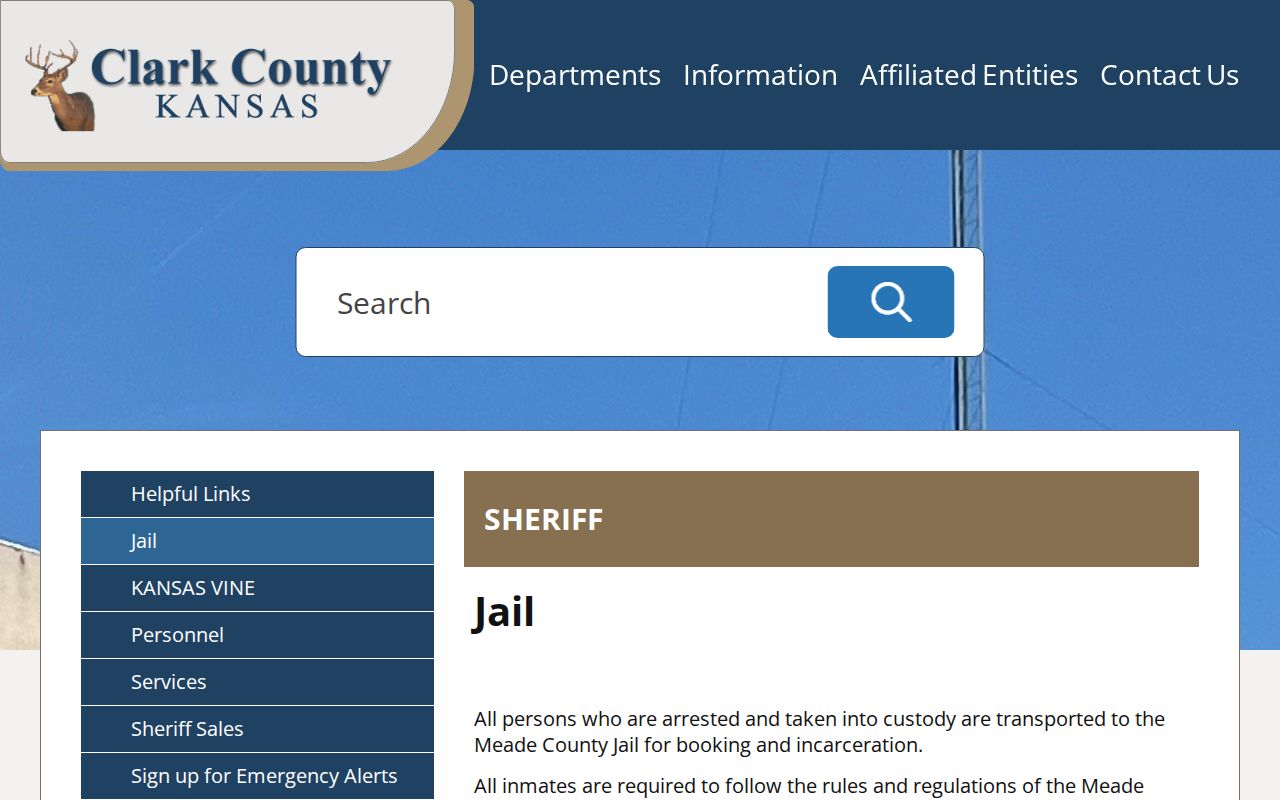
The screenshot should be read as agency guidance, not as a current list of people in custody.
Where Clark County Inmates Go
Clark's release search crosses county lines. Meade County is the stated regular jail. April 2025 county commission minutes also document temporary housing in Ford County when capacity was full and intakes had risen. That evidence does not prove that any named person went to Ford. It shows why a failed Meade search should lead to a routing question, not an unsupported conclusion.
Start with Clark County Sheriff and ask who physically held the person on the relevant date. Then contact that custodian. If Ford discharged a Clark detainee, Ford owns the physical timestamp and disposition, while the Clark criminal case usually remains in the 16th Judicial District. If the jail record says KDOC, ICE, USMS, juvenile authority, or another jail received the person, switch to that system. A transfer date is not a community-release date.
Ask “which agency physically held and discharged this person?” The arresting county alone does not answer that question.
Find Released Clark County Inmates
No official Clark or Meade rolling recent-release feed was found. Meade's “Inmate Search” page routes users to Kansas VINE rather than publishing a roster. The full Clark County released inmate search therefore uses a verified chain.
- Call Clark County to identify Meade, Ford, or another physical custodian.
- Check the named person in Kansas VINE if an adult participating county jail held them. Save the event and search time.
- Request the jail's release entry. A disappearance can also mean transfer, delay, correction, or name mismatch.
- Search the Clark County court case for the bond order, disposition, sentence, transfer authority, dismissal, or later discharge.
- Use KASPER only when KDOC incarceration or supervision applies. Use BOP, ICE, or authorized juvenile channels for those separate systems.
- Obtain a signed order, certified copy, or agency discharge record when durable proof is required.
The Released Last 24 Hours and Released Last 72 Hours pages explain why no official rolling feed can be reproduced. They provide person-specific fallback routes without calling VINE a historical archive.
Search Clark County KDOC Releases
KASPER, the Kansas Adult Supervised Population Electronic Repository, covers people and cases associated with KDOC-operated or KDOC-funded programs. It does not include every short stay at Meade County Jail. Begin at the KASPER search, accept the official disclaimer, and use a KDOC number when known. A surname and given name can work, but aliases and shared birth dates require careful identity comparison.
| Search option | How to use it |
|---|---|
| KDOC number | The most direct identifier when it is known. |
| Name and aliases | Start broad, then compare identity details and photographs. |
| KBI number | An advanced identifier for a known state record. |
| Birth date or age range | Helps separate similar names; do not rely on it alone. |
| Conviction county | Clark narrows case origin, not current home or release destination. |
| Photo controls | A KDOC image can aid identity but is not proof of present custody. |
Open the matching record and quote each status and date exactly as labeled. Projected release, parole eligibility, conditional release, maximum date, and supervision end are not interchangeable. A person on parole or mandatory postrelease lives in the community but is not finally discharged. KASPER updates on working days, and its disclaimer identifies a community-corrections probation display gap after April 21, 2021. Check probation with the court or responsible community corrections office.
The official search entry appears below before any person-level selection.
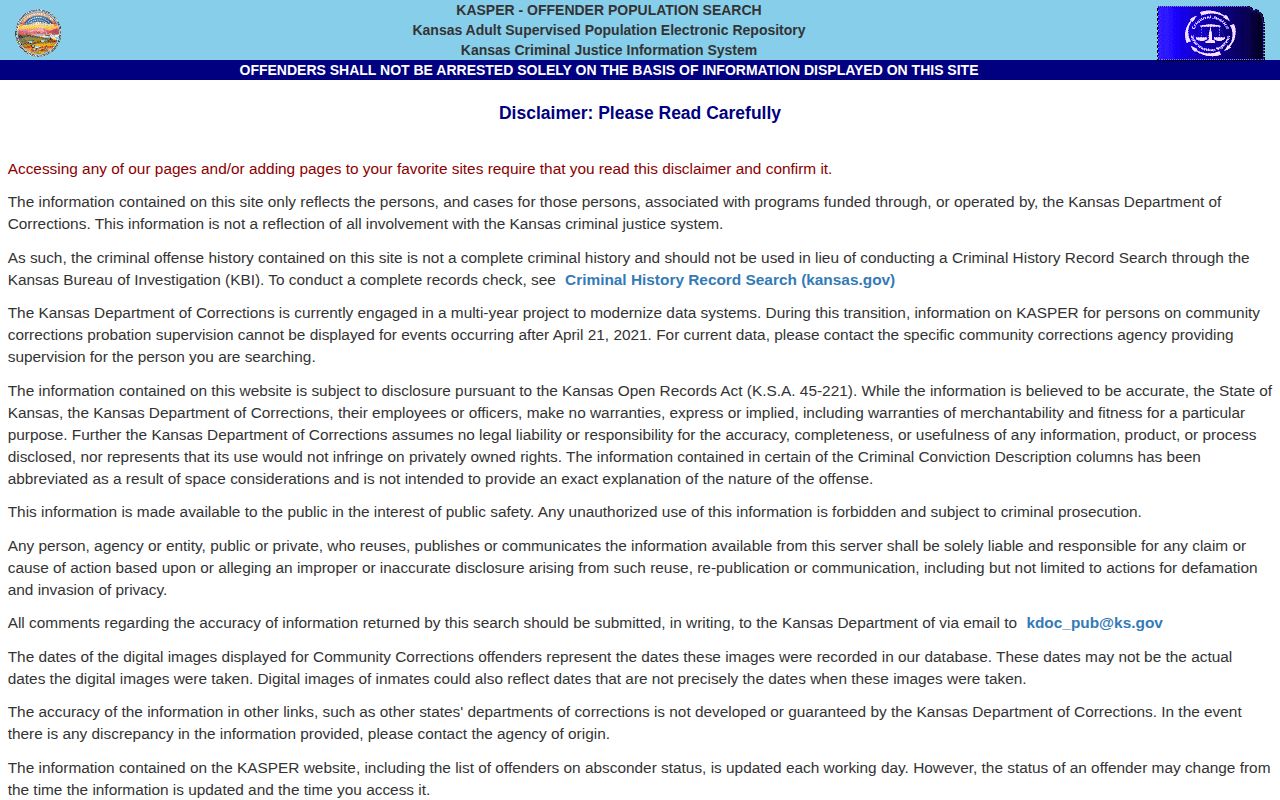
The search screen is a path to KDOC records, not a substitute for a Meade County jail release entry.
Clark Release Orders in Court
The court record often gives the lasting explanation after a live custody entry disappears. Clark County belongs to Kansas's 16th Judicial District. Search the Kansas district court records gateway by party name or case number, select Clark County, and review the register of actions. Look for bond orders, amended charges, plea or verdict, dismissal, judgment, sentence, probation, revocation, warrant, and discharge entries.
For signed orders, certified copies, older documents, or material outside remote access, contact Clark District Court at 913 Highland, P.O. Box 790, Ashland, KS 67831, 620-635-2753. Published public hours are weekdays from 8:30 a.m. to noon and 1:00 to 4:30 p.m. Verify them before travel. The official district directory identifies the court structure.
Ordinance matters may live in a municipal court instead. Minneola Municipal Court publishes a first-Monday monthly session at 4 p.m. A municipal disposition and the county jail's physical release time remain separate facts. For an Ashland municipal matter, verify the record directly with the city.
Verify Clark Post-Release Supervision
A prison release may start parole or mandatory postrelease rather than end the Kansas sentence. Search KASPER first, then use the KDOC parole office directory. Clark County is assigned to the Dodge City Parole Office at 208 W. Spruce, Dodge City, KS 67801, 620-225-1233. The automated reporting number is 866-570-7225.
Probation usually runs through the court and community corrections, not state parole. A blank KASPER screen cannot prove that probation ended. Read the Clark docket for an order of discharge or revocation. For state cases, a final discharge certificate under K.S.A. 22-3722 is stronger evidence that the entire obligation ended than a status showing only that the person is not incarcerated. The Parole / Probation page separates parole, postrelease, probation, absconder flags, and final discharge.
Clark Release Alerts and Transfers
Kansas VINE is the primary notification route linked by Clark and Meade. It covers adult offenders in participating county jails. It excludes KDOC prisoners, juveniles, and federal detainees. Search one person at the Kansas VINELink page, compare the reporting facility and identity information, and read the event literally. A VINE release event reports a county-jail custody change. It does not establish dismissal or the end of all custody.
Register for phone, text, email, or in-app notice from the matched record. Telephone registration is available at 1-866-574-8463. Save the notice, then obtain the jail record or court order. Use VINELink Release Check for the complete person-check and alert process.
Federal and immigration paths are separate. The BOP Inmate Locator can show a historical release date for some federal prisoners from 1982 forward. “Released” or “Not in BOP Custody” does not rule out another custody system or federal supervised release. The ICE detainee locator is mainly a current-location tool, not a release archive. No official source establishes a standing Clark or Meade ICE facility, so use it only when a record indicates an immigration handoff.
Discharge Records Support Expungement
Kansas expungement timing can run from sentence satisfaction or discharge from probation, community corrections, parole, postrelease, conditional release, or a suspended sentence. Under K.S.A. 21-6614, many eligible lesser conviction categories use at least a three-year wait, while listed more serious categories commonly use at least five years. Exclusions and special rules apply. The statute and current forms must control any specific filing decision.
This timing makes a discharge order or certificate valuable long after a jail roster vanishes. The jail release date may mark only the end of detention. A probation discharge order or KDOC final discharge can mark the later event from which a statutory period runs. The Kansas Supreme Court's fiscal-year fee orders can change, so verify the current filing cost rather than relying on an old amount. Expungement can restrict official access, but it does not guarantee removal of copies obtained earlier by other parties.
Where Clark Release Status Appears
Choose a system by custody type. An absence in one database is never a universal release result.
| System | Best use | Key limit |
|---|---|---|
| Clark Sheriff | Arrest, transport, incident, and Clark-held property records | Usually not the booking or discharge custodian |
| Meade or Ford jail | Booking number, timestamp, disposition, and receiving agency | A transfer is not a community release |
| Kansas VINE | Participating adult county-jail event and notification | Not KDOC, juvenile, or federal coverage |
| KASPER | State correctional status, dates, and supervision | Not every county-jail stay or current probation event |
| District or municipal court | Bond, disposition, sentence, and discharge orders | The docket may not show physical release time |
| BOP or ICE | Custody-specific federal paths | No result does not prove community release |
Clark County Release Facilities
Each facility page follows the record to the system that controlled custody. Clark handles arrest and routing; Meade is the regular jail; Ford is a documented overflow option; the regional juvenile center uses protected channels; KDOC controls state prison release; BOP covers federal imprisonment; and ICE manages civil immigration detention.