
Clark Release Date Sources
Clark County sends adults taken into custody to Meade County Jail, with documented temporary overflow to Ford County. That regional setup makes the first question simple: who physically holds the person now? A pretrial detainee's release turns on bond, a court order, a detainer, or another case event. Meade or Ford can confirm its own booking, release, or transfer entry, while the Clark County court explains the authority.
KDOC becomes the main source after a state commitment. KASPER can show correctional status and release-related dates for people within KDOC's scope. A movement from Meade to KDOC is not community release. Federal cases require the federal docket, USMS route, or BOP locator. Juvenile dates are restricted and must be sought through lawful family, counsel, court, or agency channels.
| Custody | Date source | What to confirm |
|---|---|---|
| Clark arrest at Meade/Ford | Physical jail and Clark court | Bond order, release time, disposition, transfer |
| KDOC prison | KASPER, KDOC, court judgment | Exact projected, eligibility, or supervision label |
| Federal custody | BOP, federal docket, USMS | Federal release date and later supervision |
| ICE or juvenile | Custody-specific lawful channel | Transfer versus true release |
Find Clark Projected Release Dates
Use identifiers tied to the correct episode. A jail booking number, Clark case number, or KDOC number is more precise than a name alone. Do not treat the day a person left Meade as the date a state prison term ended. If the jail entry says transfer to KDOC, continue in KASPER and compare the state record with the commitment order.
- Call Clark County Sheriff to identify whether Meade, Ford, KDOC, or another agency received the person.
- For county custody, ask the physical jail for the booked name, booking number, current status, release authority, and any transfer destination.
- Read the Clark court docket and obtain the bond, sentencing, commitment, or amended order that controls the custody event.
- For state custody, open KASPER, search by KDOC number or name, and quote each date with its exact label.
- Confirm a date that matters with the current custodian. Then use the VINELink Release Check only for participating adult county-jail events.
The official KASPER search provides the statewide entry point for KDOC cases.
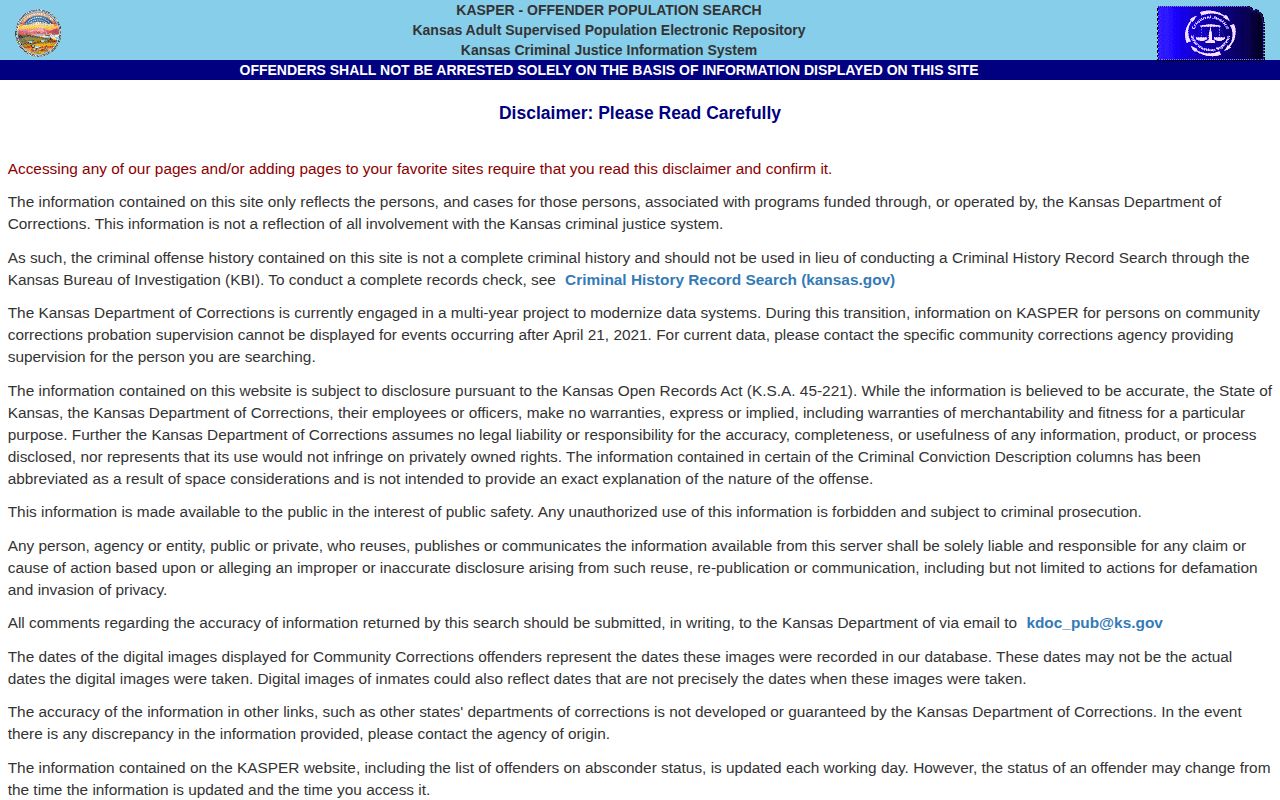
KASPER does not cover an ordinary short Clark or Meade jail stay. It also updates on working days, so a new order or weekend change may not appear at once.
Note: Record the search time and exact date label before asking an agency to reconcile a mismatch.
Clark State Release Date Labels
Kansas law and records use several dates that cannot safely be merged. A projected release date can mark the expected start of postrelease supervision. Parole eligibility means an eligible person can be considered; it is not a grant. A conditional release date, maximum date, postrelease end date, and final discharge date each answer a different question.
K.S.A. 22-4302 describes correctional-history content and uses the phrase “projected release date for the commencement of the postrelease supervision term” for covered crimes. That wording shows why prison release may begin supervision instead of ending the sentence. The live KASPER record must be quoted as displayed because field availability varies by record and sentence era.
- Projected release
- An estimate based on the sentence and credits currently retained.
- Parole eligibility
- The point when an eligible case may be considered for discretionary parole.
- Postrelease
- Community supervision after the prison part of many determinate sentences.
- Final discharge
- The documented end of the state correctional obligation.
For an eligible parole case, the Prisoner Review Board may grant, continue, or pass the matter. Even a grant does not create release before statutory eligibility and lawful processing. For many determinate post-1993 cases, the Board sets conditions but cannot advance or delay the statutory release date.
Clark Good-Time Date Rules
Kansas's common “85%” shorthand is not universal. Under K.S.A. 21-6821, eligible severity levels 1 through 6 may earn good time up to 15 percent of the prison term. Eligible levels 7 through 10 may have a 20-percent cap. Certain eligible persons can receive up to 120 days of program credit. Those rules have exclusions, offense-date limits, and sentence details that prevent a sound one-line calculator.
The official good-time statute is the source for the current framework.
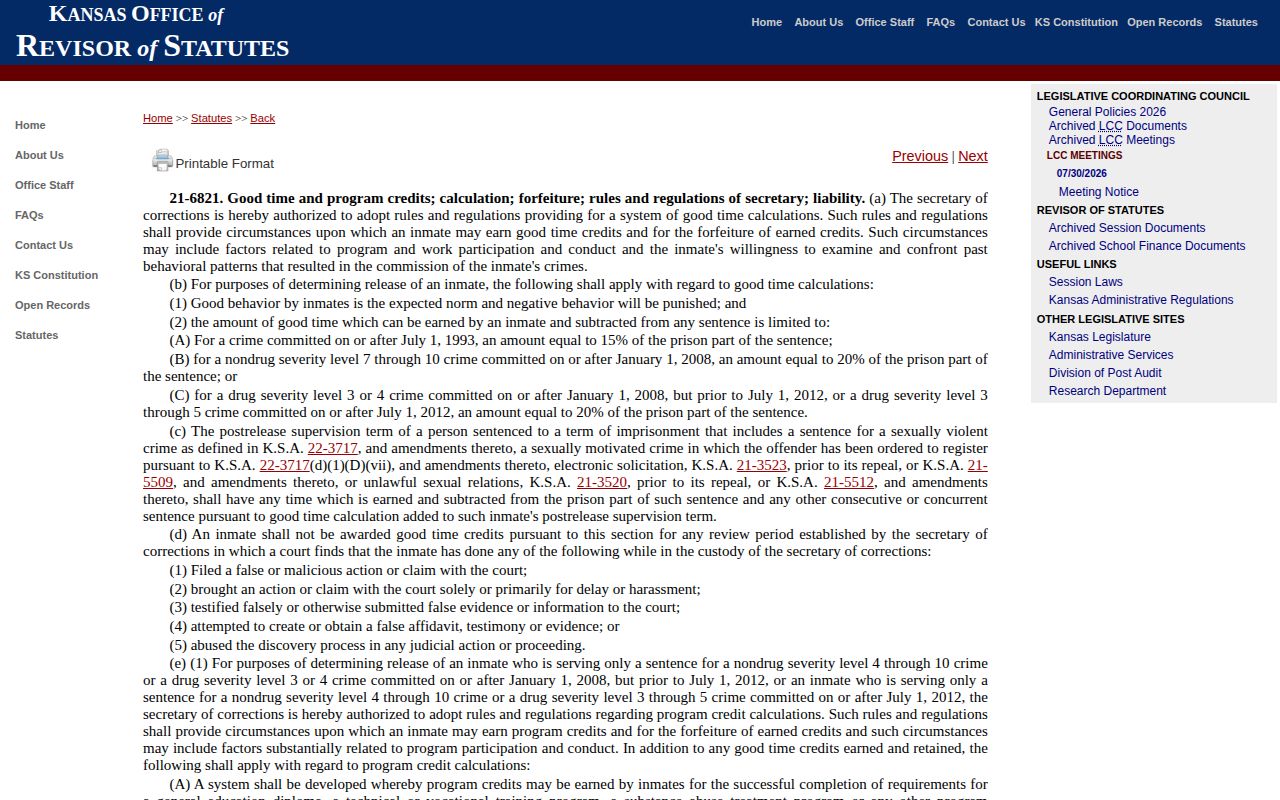
The statute image supports the credit rules, but it cannot calculate one person's date without the judgment, offense date, severity level, sentence structure, and retained-credit record. Credits may be earned, withheld, forfeited, or restored under governing rules.
Old-law indeterminate cases use a different framework under K.S.A. 22-3725. Parole eligibility may reflect a minimum term less applicable good time, yet eligibility still does not promise a grant. Off-grid, mandatory-term, and life-without-parole categories have separate restrictions.
Note: Tie every Clark County projection to the offense date, sentence type, severity level, and credits actually retained.
What Changes Clark Release Dates
A projected date can move for lawful reasons. Sentence correction may change the base term. Consecutive cases can extend the aggregate term. Jail credit may be recalculated. Disciplinary action can affect earned credit, while approved program credit can reduce the prison portion for an eligible person. An appellate order or amended journal entry can also alter the date source.
| Change | Possible effect | Record to check |
|---|---|---|
| Earned or lost credit | Moves a projection within legal limits | KDOC sentence and credit record |
| Program completion | May add eligible program credit | KDOC award record |
| Sentence correction | Changes the controlling term | Amended court order and KDOC record |
| Consecutive structure | Combines terms in a set order | Judgment and sentence computation |
| Detainer or transfer | May prevent community release | Jail disposition and receiving agency |
| Parole outcome | Grant, continuation, or pass in eligible cases | PRB and KASPER confirmation |
A release plan can shape approved residence, reporting, and logistics without rewriting the statutory computation. Likewise, a VINE event from Meade only reports the county-jail custody change. It cannot predict KDOC release after a transfer.
Clark County Jail Date Limits
County-jail calculations are not KDOC calculations. A person held before trial may leave after bond or a judge's order, and no fixed release date may exist beforehand. A county sentence depends on the judgment, jail credit, other holds, and applicable local or statutory rules. Research found no published Clark or Meade county good-time or weekend-release policy.
Ask the jail administrator and Clark court clerk to interpret the controlling record. The jail can confirm processing and the physical departure time. The signed order explains legal authority. If the disposition says transfer, contact the receiving agency. The Clark County released inmate search explains the complete records chain for an event that has already occurred.
Do not transplant KDOC's 15-percent or 20-percent caps into a Meade County jail estimate. Also avoid assuming release must happen on a business day. Without a published local policy or order for the case, the safe answer comes from the physical custodian.
Bond and sentence completion must also remain distinct. Bond permits a person to leave pretrial detention while the case and conditions continue. Time served describes the custodial part recorded by the jail, but another case, fine, supervision term, or agency hold may remain. A dismissal concerns the prosecution and should be confirmed through a signed court entry. None of those labels should be replaced with a generic projected date.
When Clark cannot locate the expected booking, ask whether the person was sent directly to Meade, temporarily held at Ford, transferred under another authority, or entered under an alias. The April 2025 Clark commission minutes document Ford overflow during a period of full capacity, but they do not prove Ford held a particular person. Only the routing record and receiving jail can establish that fact.
Confirm Clark Actual Release
The projected date should be checked again near the expected event. Ask whether the person remains in the named facility, moved to another agency, began parole or postrelease, or received a changed date. After departure, request the release timestamp and disposition from the actual custodian. A court order, VINE notice, or KASPER update can support that record, but each has a narrower role.
For final completion, seek more than “not incarcerated.” A KDOC discharge certificate under K.S.A. 22-3722 or a signed probation discharge order documents the end of supervision. Someone can be outside a prison and still have a state obligation. Keep projected prison release, actual gate release, supervision start, and final discharge as separate entries.
A mismatch should be resolved at its source. If KASPER and a court judgment appear to show different terms, ask KDOC to review the correctional record and provide the exact order being used. KDOC directs written accuracy questions to kdoc_pub@ks.gov. If the jail and court disagree about a recent Clark event, ask the physical jail whether its timestamp marks staff entry or actual departure, then obtain the signed order from the Clark clerk. Preserve both answers. One office should not be asked to interpret a date owned by another agency.
Release to another authority also needs careful wording. A Meade entry that closes when KDOC, USMS, ICE, another county, or a juvenile authority takes custody is a discharge from that jail's control, but it is not release to the community. Record the receiving agency and transfer time. Then use the receiving system for the next projected or actual date. This prevents a county departure from being reported as the end of a state or federal term.
Negative results are not proof. Check aliases, identifiers, update lag, transfers, restricted juvenile data, and federal or immigration custody. A focused records request is the durable fallback when live systems disagree and provides a lasting account of the Clark County release date.
Public Record Search
Sponsored Results