
KDOC Release Records Differ
The Kansas Department of Corrections runs state prisons and state parole or postrelease supervision. It does not administer Meade County Jail, Ford County Jail, or the Clark County Sheriff's Office. A person enters the KDOC path after a state court commitment or through a KDOC-funded program. A brief county-jail stay does not create a KDOC record merely because the arrest occurred in Kansas.
For a Clark County case, the jail may record “transfer to KDOC.” That entry marks the end of the jail stay, not community release. Compare it with the court commitment and search KASPER, the Kansas Adult Supervised Population Electronic Repository. Later prison release, parole, mandatory postrelease, and final discharge are state events.
Search KDOC Released Offenders
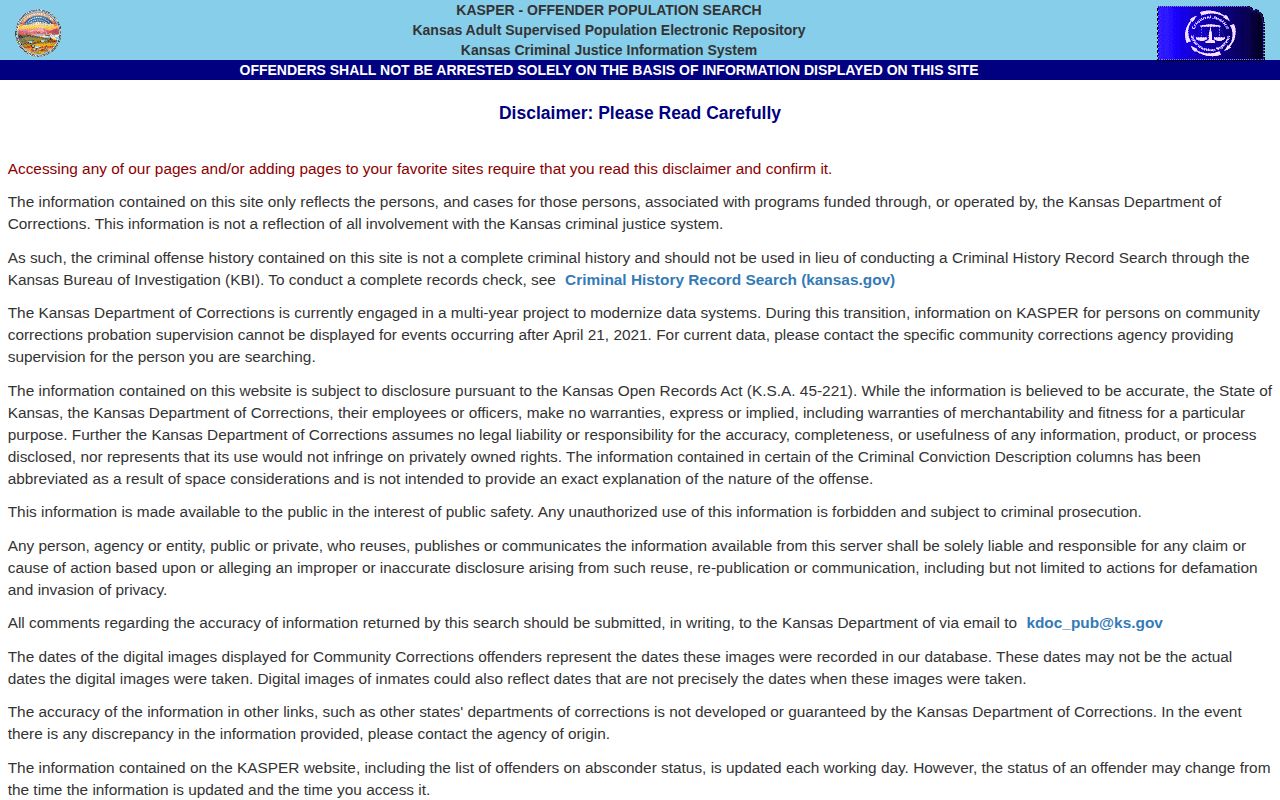
Begin at the official KASPER disclaimer. Read the limits, select Agree, and open the offender-population search. A KDOC number is the strongest key. Otherwise start with surname and given name, enable aliases when warranted, and compare identity details. The form also offers middle name, photographs, State ID or KBI number, race, gender, birth date, age range, and conviction county. “Clark” as conviction county means the case originated there. It does not show residence or a release destination.
- Open the KASPER disclaimer and enter the public search.
- Use the KDOC number when available, or search the booked legal name.
- Compare identity fields and photographs before choosing a result.
- Open the record and quote each status and date with its exact label.
- Confirm a key event with KDOC, PRB, or the court record.
KASPER may show identity data, a correctional photograph, status, location or supervising office, convictions, admission information, and release-related dates. Fields differ by record and sentence era. Do not rename parole eligibility, conditional release, maximum date, projected release, or supervision end as a guaranteed gate date. Updates occur on working days.
Read KDOC Release Status
Incarceration means the person remains under state correctional authority. Parole is discretionary community release for eligible sentences under Kansas Prisoner Review Board conditions. Mandatory postrelease follows the prison part of many determinate sentences. Final discharge is the later end of the state obligation.
| KDOC stage | Meaning |
|---|---|
| Incarcerated | State custody continues |
| Parole | Community placement under state conditions |
| Postrelease | Prison ended but KDOC supervision continues |
| Final discharge | The state obligation ended as documented |
K.S.A. 22-3722 provides for final discharge and a certificate after satisfactory service. That certificate is stronger evidence than a bare “not incarcerated” inference. A Clark conviction also does not prove the person returned to Clark after prison.
Interpret KDOC Release Dates
K.S.A. 22-4302 refers to a projected release date for the start of postrelease supervision for covered crimes. A projection is not a promise of physical departure. Earned or forfeited credit, program credit, discipline, sentence correction, consecutive terms, jail credit, appeals, offense date, severity, and special rules can change the calculation.
The “85 percent” shorthand is incomplete. Some cases have a 15-percent good-time cap, eligible lower-severity cases can have a 20-percent cap, and qualifying programs may affect credit. Old-law indeterminate cases use another framework. Start with the offense date, sentence, severity, and exact field label. County bond and time-served decisions do not use the KDOC prison formula.
Verify KDOC Postrelease Supervision
KASPER is the first public lead for parole and postrelease. It separates parole absconders from community-corrections absconders. An absconder is alleged to be knowingly avoiding supervision or making whereabouts unknown under K.S.A. 75-5217. That flag is not a new conviction and can lag.
Probation is usually controlled by the court and community corrections, not state parole. KASPER warns that community-corrections probation events after April 21, 2021 cannot display during modernization. A blank entry cannot show probation ended. Read the Clark docket and obtain the order.
Clark County is assigned to the Dodge City Parole Office, 208 W. Spruce, 620-225-1233. Use it for lawful procedural verification, but do not publish a personal reporting schedule or home address.
Obtain KDOC Discharge Records
Use KASPER for the public lead, then ask the creator for the needed record. KDOC addresses prison history and state status. The Prisoner Review Board controls its parole and discharge work. Clark District Court supplies the judgment, commitment, sentence, and later orders.
A focused request gives the name, KDOC number, Clark case if known, and exact record sought. Ask for an existing release entry, PRB action, supervision end, or discharge certificate. KDOC directs written KASPER accuracy concerns to kdoc_pub@ks.gov.
The official KASPER page provides the statewide search entry.
This search belongs to KDOC records, not every Clark booking.
KDOC Release Record Contacts
The Clark County parole and probation guide distinguishes state supervision from court probation.
208 W. Spruce
Dodge City, KS
620-225-1233
Automated reporting: 866-570-7225
The Prisoner Review Board is at 714 SW Jackson Street, Suite 300, Topeka, KS 66603. Its public-comment contact is 785-746-7516 and KDOC_PRB_Public_Comment@ks.gov. Verify the right records recipient before sending identity details.
KDOC Search Result Limits
A negative KASPER result has a narrow meaning. The person may have had only a county-jail stay, may be listed under an alias, may have a different conviction county, or may fall outside the public-data scope. Community-corrections modernization can also leave recent probation activity unavailable. Record the name spelling, filters, and search date. Then return to the actual custodian instead of treating an empty screen as proof of release.
When a Meade record says transfer to KDOC but the state result has not appeared, compare the booking number, court commitment, and transfer date. Intake processing can separate the county departure from the first useful state display. Contact the jail for the receiving agency and use the Clark clerk for the signed commitment. Those official source records are much more reliable and precise than guessing from a live portal gap.
A displayed correctional photograph is an identity aid, not proof of present custody. A listed conviction is also not a complete court file. Use the record to locate the right person and state event, then obtain the originating order or certificate when durable proof is required. Kansas VINE does not cover KDOC prisons, so a county VINE notice cannot replace KASPER for this state-custody stage.
PRB Release Decision Evidence
The Kansas Prisoner Review Board publishes monthly public-comment schedules and lists of people approaching eligible hearings. A listing includes commitment name, KDOC number, conviction county, case number, offense code, and indicators under facility groupings. Conviction county is not the destination after release. Appearance on a list shows that a hearing is scheduled, not that parole was granted.
PRB describes parole, continue, and pass as distinct outcomes. Parole means the Board found the eligible person suitable, subject to lawful processing and conditions. Continue postpones the matter for information, deliberation, votes, or evaluation. Pass denies release for a stated period. Even a grant cannot produce release before statutory eligibility. For one person, compare the monthly material with KASPER and ask PRB for the applicable action. No separate official person-level decision search was found.
Trace Clark to KDOC Custody
A Clark arrest normally begins with routing through the sheriff and booking at Meade. Ford may appear when overflow is confirmed. If the court imposes a state commitment, the physical jail records transfer to KDOC. That transfer date is not the later prison release date. Match the jail disposition with the signed commitment, then use KASPER for state intake, location, status, and dates.
If KASPER later shows community supervision, the person may have left the prison institution while remaining on parole or mandatory postrelease. Read the exact status. Contact the Dodge City Parole Office for lawful procedural verification. To establish the end of the whole state obligation, seek a final discharge certificate rather than relying on “not incarcerated.”
Preserve KDOC Date Labels
Do not collapse all correctional dates into “release date.” Parole eligibility concerns when an eligible case may be considered. A projected release date concerns a calculation under the applicable sentence rules. Conditional release and maximum dates have distinct legal meanings. The end of postrelease supervision occurs after the prison portion and community term. Quote the live label and value together.
A date can change through credit awards or loss, program completion, discipline, sentence correction, consecutive structure, appellate action, or a new court order. A release plan can affect conditions and logistics without rewriting the statutory computation. The court judgment, KDOC calculation, and PRB action therefore answer different questions.
Search KDOC Release Records
Use a name search as a lead, then verify the state event with KDOC or the Prisoner Review Board.
Public Record Search
Sponsored Results