
Clark Release Supervision Types
Parole, postrelease supervision, and probation can all place a person in the community under rules, but they begin through different legal paths. Traditional parole is a discretionary release tied mainly to older-law, indeterminate, off-grid, and other specified Kansas sentences. Most determinate non-off-grid crimes committed on or after July 1, 1993 instead lead to mandatory postrelease supervision after the prison portion. Probation is usually ordered by a court and managed through court services or community corrections.
The distinction determines which Clark County record to trust. KASPER, the Kansas Adult Supervised Population Electronic Repository, is the first public lead for KDOC parole and postrelease. The Clark County court docket and the responsible community corrections program are stronger paths for probation, especially because KASPER reports a modernization gap for community-corrections probation events after April 21, 2021.
| Status | How it begins | Best Clark County check |
|---|---|---|
| Parole | Prisoner Review Board grants community release in an eligible case | KASPER, then KDOC parole services |
| Postrelease | Follows the prison part of many determinate Kansas sentences | KASPER and Dodge City Parole Office |
| Probation | Clark County court orders community supervision | Court docket, signed order, and supervising program |
| Final discharge | The full supervision obligation ends | Discharge order or KDOC certificate |
- Parole
- Conditional community release governed by the Prisoner Review Board in an eligible case.
- Probation
- A court-ordered community sentence that may avoid or follow confinement.
- Postrelease
- Mandatory community supervision after the prison part of many determinate sentences.
- Discharge
- The documented end of the correctional or supervision obligation.
Verify Clark Post-Release Supervision
Begin with the custody path, not a broad name search. A brief Clark arrest housed at Meade County Jail does not by itself create a KDOC record. State commitment, parole, or postrelease makes KASPER relevant. A Clark probation order may remain chiefly in the district-court file. Keep the booked name, date of birth, case number, and KDOC number separate so records for people with similar names are not combined.
- Search the KASPER portal by KDOC number when known, or by name and identifying details.
- Open the matching result and quote the displayed status, office, and date labels exactly. “Not incarcerated” does not mean discharged.
- For parole or postrelease, compare the result with the official KDOC parole office directory and contact Dodge City for a current procedural check.
- For probation, search the Clark County docket and obtain the discharge, revocation, or modification order from the clerk.
- When the goal is to prove supervision ended, request the final order or discharge certificate instead of relying on an absent web result.
KASPER data is updated on working days. A same-day or weekend change can lag. Names, aliases, and sentence eras also affect what appears. The full Clark County release search and records-request path is covered on the Clark County released inmates home page.
The official KASPER search landing page shows where a state correctional lookup begins.
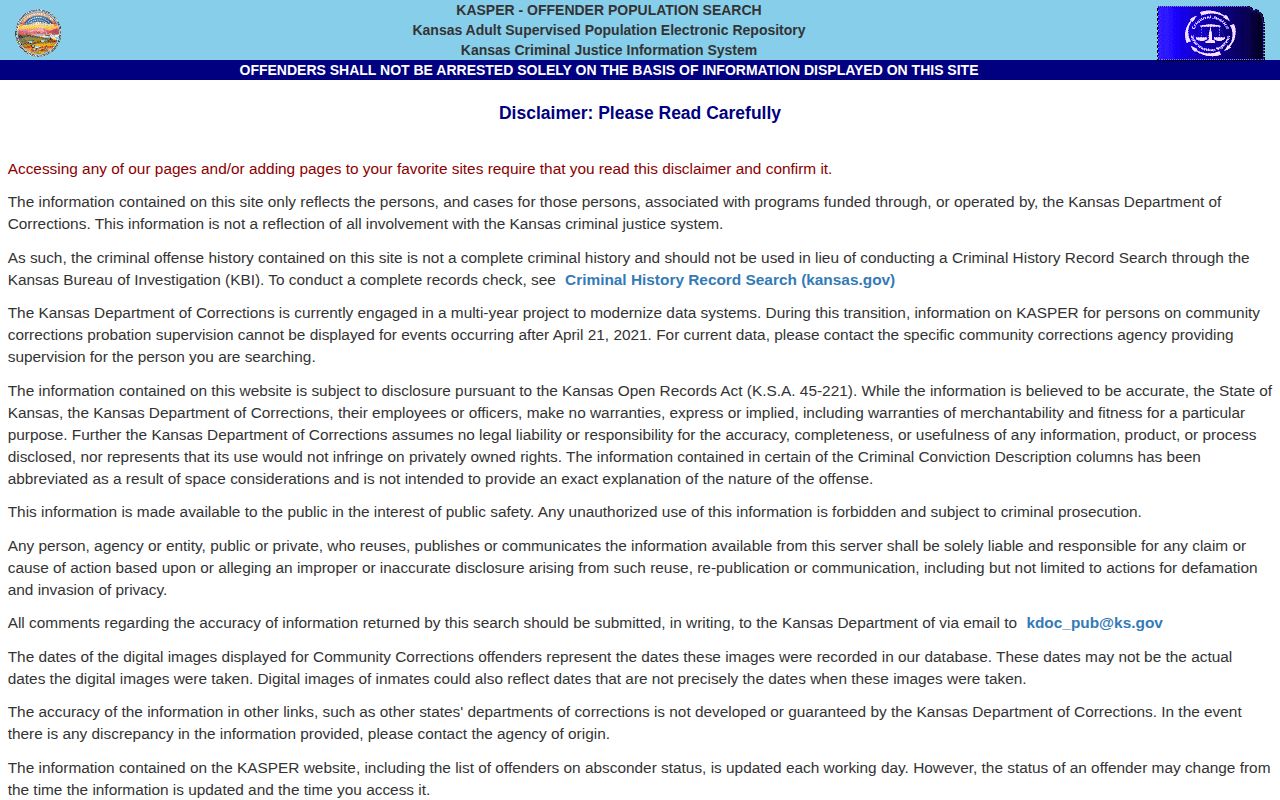
This screen applies to people in KDOC's scope. It is not a substitute for a Meade County booking record or a Clark probation order.
Note: Save the date, spelling, identifiers, and exact status label used in each Clark County supervision check.
Clark Parole Office Verification
Clark County has no local state parole office. KDOC assigns the county to the Dodge City Parole Office in the South Region. The office and KASPER serve different roles. KASPER supplies a public status lead, while parole staff can explain the current agency route when information is lawfully releasable. A conviction county filter does not show where a person now lives or where release occurred.
208 W. Spruce
Dodge City, KS 67801
620-225-1233
Automated Reporting System
866-570-7225
The official KDOC parole contacts page is the source for the Clark assignment. Do not request or publish a personal reporting schedule or home address. Ask whether the office can confirm the type of state supervision, which office is responsible, and the proper way to seek a discharge record.
The KDOC office directory image helps distinguish an online status search from contact with the actual supervising region.

For a Clark probation case, use the court route instead. KDOC expressly warns that newer community-corrections probation events may not display during modernization, so a blank KASPER record cannot prove probation ended.
Clark Parole Hearing Records
The Kansas Prisoner Review Board handles parole-suitability work for eligible cases. Its monthly public-comment material concerns upcoming cases, not a complete person-level decisions database. A listed person is scheduled for a process; listing does not mean parole was granted, and disappearance from a later list does not prove release.
The Prisoner Review Board hub links the official process. The rolling public-comment schedule and listed-person page can provide a case lead. The listed page may show commitment name, KDOC number, conviction county, case number, offense code, and facility grouping. Conviction county is not a promised release destination.
The official Board page provides the right starting point for Clark County parole hearing information.

For one person's outcome, compare KASPER and confirm with the Board or parole office. “Continue” postpones action, while a “pass” denies parole for a period. A grant still cannot create release before statutory eligibility and processing.
Clark Supervision Absconder Status
KASPER separates parole absconders from community-corrections absconders. Kansas law defines absconding around knowing avoidance of supervision or knowingly making one's whereabouts unknown to the supervising officer. The public flag is a status lead. It is not a new conviction, proof of a person's current location, or a real-time warrant return.
Check the KASPER disclaimer before interpreting the result. Its working-day update schedule means the display may lag. The responsible agency can address current procedure, and the Clark court docket may show a probation warrant, revocation filing, modification, or later order. Avoid acting on a web flag alone.
Violations can lead to continued supervision, changed conditions, or revocation after lawful proceedings. Conditions vary by case and can include reporting, approved residence or travel, treatment, program participation, and compliance with court or Board directives. Only the actual order and supervising agency establish the rules for one person.
Note: An absconder listing signals unresolved supervision, not a separate finding of guilt.
Property After Clark Release
Clark County publishes a local deadline that matters after release. Personal items left at the Sheriff's Office in Ashland are held for 30 days after release and then disposed of. That rule applies to Clark-held property. It does not establish how Meade County Jail, Ford County Jail, KDOC, or another custodian handles items.
Contact the Clark County Sheriff at 620-635-2802 promptly and ask what identity, authorization, and pickup steps apply. If the person was booked in Meade or held in Ford overflow, call that physical custodian about jail property. Keep the property issue separate from parole reporting and discharge. One deadline does not pause the other.
The official Clark County jail information page supplies the 30-day rule. A family member should not assume that possession can be released without the named person's authorization.
Clark Supervision Final Discharge
Leaving prison is not the same as leaving KDOC authority. A person may move from a facility into parole or mandatory postrelease and remain supervised in the community. Under K.S.A. 22-3722, satisfactory service can lead to final discharge and a certificate. That document is stronger proof of the endpoint than a simple “not incarcerated” status.
For probation, seek the signed Clark County order that discharges probation or otherwise closes the supervision term. For parole or postrelease, ask KDOC or the Prisoner Review Board about the discharge certificate. Keep court completion, jail release, prison release, and state discharge as separate dates. They often answer four different questions.
Expungement timing under Kansas law may run from sentence satisfaction or discharge from probation, parole, postrelease, conditional release, or related supervision. That is another reason to preserve the actual discharge order or certificate rather than depend on a live portal that may later change.
A Clark County court record and a KDOC record may close at different points. The jail release marks the end of one custodian's hold. A prison release may begin postrelease. A probation order may remain active even when no person appears in a jail or prison search. Build the timeline with the order date, physical release date, supervision start, modifications, and final discharge. If a date conflicts, ask the agency that owns that part of the record to explain it.
Records requests should be narrow. Give the full name, KDOC number or Clark case number, and the type of document sought. For state supervision, ask KDOC or the Board for an existing discharge certificate or decision record. For probation, ask the Clark clerk for the signed discharge or revocation order. A portal printout is useful for finding the file, but a certified copy from the originating office is stronger when formal proof is needed.
Supervision conditions and release notifications also serve different needs. Kansas VINE tracks participating adult county-jail custody events, not KDOC parole, state prison, juvenile, or federal status. A VINE release alert from Meade does not answer whether Clark probation began. Use the court and responsible program for that question. Likewise, a KBI registry entry reflects a statutory registration duty, not a parole or probation term.
Public Record Search
Sponsored Results